Monday, August 24, 2015
Greater Glider
The greater glider (Petauroides volans) is a small gliding marsupial found in Australia. It is not closely related to the Petaurus group of gliding marsupials but instead to the lemur-like ringtail possum (Hemibelideus lemuroides), with which it shares the subfamily Hemibelideinae. The greater glider is nocturnal and is a solitary herbivore feeding almost exclusively on Eucalyptus leaves and buds. Like its relative the lemur-like ringtail, the greater glider is found in two forms: a sooty brown form, or a grey-to-white form. The greater glider is found in eucalypt forest from Mossman, Queensland, to Daylesford, Victoria. Greater gliders have a head and body about 39 to 43 centimetres (15 to 17 in) long, with the females being generally larger than the males. Their body is covered with a shaggy coat of fur that increases their apparent size, and the tail is long and bushy, ranging from 44 to 53 centimetres (17 to 21 in). The head is short, but with a pointed muzzle, and large ears fringed and backed with long fur. Each side of the body bears membranes stretching between the elbow and the ankle, that give the animal the ability to perform controlled glides. This is in contrast to other gliding marsupials (such as the sugar glider) that have gliding membranes stretching from the wrists to the ankles. The feet have strongly recurved claws to grip onto bark or other surfaces. There are five toes on each foot, with the first toe on the hind foot, and the first two toes on the fore foot, being opposable. The fur is soft and up to 60 millimetres (2.4 in) long; the colour is variable within the same populations, ranging from white to brown and charcoal. Body mass varies clinally from about 1,600 grams (3.5 lb) in southern Victoria to about 600 grams (1.3 lb) in north Queensland. Heat management in the greater glider is performed by licking extremities and the ventral body surface, with direct evaporation being the main method of the cooling. Furthermore, the glider can use its gliding membranes to reduce heat loss by increasing the layer of insulation at the skin surface. However, the greater glider is not well equipped to handle high ambient temperatures, as it inefficiently uses water for evaporation via salivation even though arboreal habitats are often limited in water accessibility.
Sunday, August 23, 2015
Sea Otter
This aquatic member of the weasel family is found along the coasts of the Pacific Ocean in North America and Asia. The sea otter spends most of its time in the water but, in some locations, comes ashore to sleep or rest. Sea otters have webbed feet, water-repellent fur to keep them dry and warm, and nostrils and ears that close in the water. Sea otters often float at the water's surface, lying on their backs in a posture of serene repose. They sleep this way, often gathered in groups. Otters sometimes float in forests of kelp, or giant seaweed, in which they entangle themselves to provide anchorage in the swirling sea. These aquatic otters do more than sleep while floating on their backs. They are often seen with a clam or mussel and a rock that has been deftly snared from the ocean floor. Otters will place the rock on their chests, and repeatedly smash the shellfish against it until it breaks open to reveal the tasty meal inside. They also dine on such aquatic creatures as sea urchins, crabs, squid, octopuses, and fish. Sea otters are the only otters to give birth in the water. Mothers nurture their young while floating on their backs. They hold infants on their chests to nurse them, and quickly teach them to swim and hunt. Sea otters are meticulously clean. After eating, they wash themselves in the ocean, cleaning their coat with their teeth and paws. They have good reason to take care of their coats—it helps them to remain waterproof and insulated against the cold. Sea otters have thick underfur that traps air to form an insulating layer against the chilly waters (they have no insulating fat). This coat is invaluable to otters, but it has worth to some humans as well.
Saturday, August 22, 2015
Ili Pika
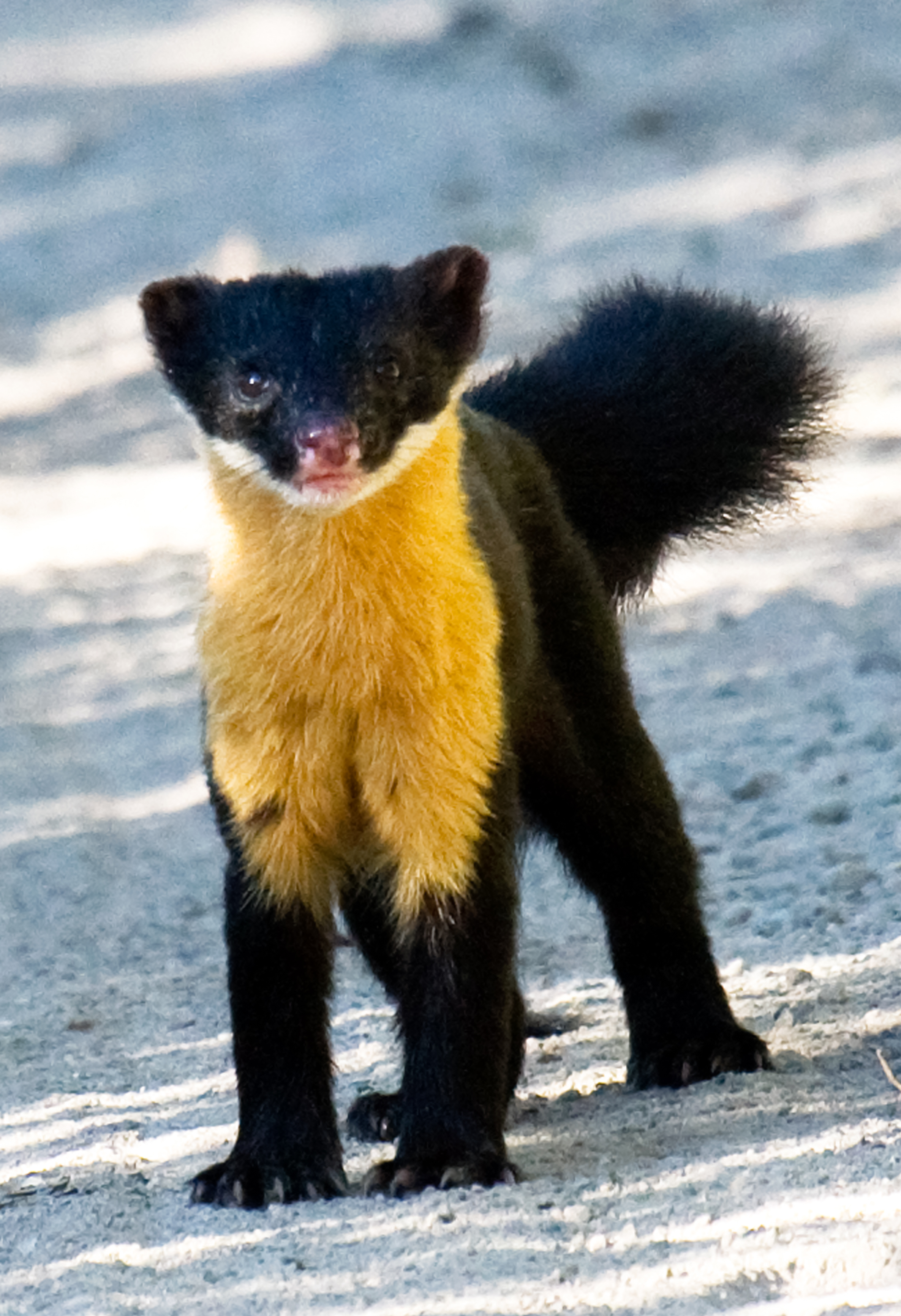
Nilgiri Marten
The Nilgiri marten (Martes gwatkinsii) is a slender and graceful mammal that is well-adapted to its semi-arboreal lifestyle. Like other martens, the Nilgiri marten is a medium-sized carnivore with wedge-shaped, rounded ears, a triangular face, moderately long body and short legs. This species is covered in soft, thick, dark brown fur, except for a striking yellow bib on its throat. It also has a bushy tail which helps it to balance, and large paws which are furry on the sole. The Nilgiri marten is very closely related to the yellow-throated marten (Martes falvigula). The Nilgiri marten and the yellow-throated marten have previously been classified as the same species by scientists. Little is known about the Nilgiri marten specifically but, like other martens in the family Mustelidae, it is an extremely agile creature. It is thought to use its strong, semi-retractable claws for clinging onto trees, and its elongated tail for stability and balance while climbing and leaping high in the treetops. Martens are generally considered active all year round and do not seem to have a set sleeping pattern, appearing to be active during the day and night. They are usually solitary animals, apart from during the summer when breeding takes place. Martens are generally polygamous breeders, and although the precise gestation period for the Nilgiri marten is not known, in most other marten species it lasts for around eight to nine months. The size of the litter can vary from one to five kits, which are born with very little fur and are blind and deaf for the first few days of life. The litter is usually weaned after about seven weeks. The young kits are able to hunt and kill their own prey by the time they are three to four months old.
Miniature Southdown Sheep
Olde English Miniature Babydoll Southdown sheep are an ancient breed with sweet, teddy bear faces. Because of their diminutive size, miniature Southdowns make outstanding weeders for use in orchards and vineyards -- they are only 24 inches tall when mature, and so can't easily reach tree branches or trellised grapes. Their small hooves help break the soil surface without compacting it. They move easily up and down hills, and can get into a field or vineyard much earlier than machinery can. And not only do they provide an organic alternative to pesticides and expensive mowing operations, their recycled grass (manure) helps improve soil fertility as well. Miniature Southdowns are usually white; however, there are also black (or brown) ones. They are easy to handle and are not aggressive. They are not wanderers and do not bother fences. Ewes are good mothers and often have twins and occasionally triplets. Care for miniature Southdown's is similar to that of other sheep, including sheering, vaccinating, foot trimming, and worming, however, as an ancient breed they are resistant to foot root and more resistant to parasites than other breeds. Their wool is short stapled and fine with a 19-22 micron count, which puts it in the class of cashmere. The Southdown breed of sheep originated in the South Downs of Sussex county, England. They are one of the oldest of the Down breeds. English farms kept these sheep for their dual-purpose--flavorful meat and fine fleece. Early literature suggests that Southdowns were among the animals brought into the English colonies as early as 1640. During this time, Britain strictly forbade the importation of sheep and the formation of America's budding woolen textile industry. In fact, in 1698, the penalty for wool-trading or sheep-trading in the American colonies was having one's right hand cut off! So spinning or weaving was an act of patriotism. Wearing clothing crafted of American woolens was done with pride. Both George Washington and Thomas Jefferson raised sheep and both chose American-made woolens to wear to their Presidential inaugurations.
Friday, August 21, 2015
Chinese Water Deer
The scientific name (Hydropotes inermis) of this unusual small deer translates as ‘unarmed water-drinker’, referring to the Chinese water deer’s lack of antlers and its liking for marshy habitats. Instead of antlers, the male Chinese water deer bears enlarged upper canine teeth, which form long, slightly curved tusks that measure up to eight centimetres in length and protrude like fangs from the side of the mouth. The female Chinese water deer is slightly smaller than the male, with much smaller canines. The coat of this species is rather thick and coarse, and is reddish-brown is summer and more greyish in winter, with whitish underparts. The ears are short and rounded, the legs are relatively long and slender, and the tail is reduced to a stump. Young Chinese water deer are darker brown than the adults, with white spots and stripes on the upper back. As its name suggests, the Chinese water deer is an adept swimmer, and may swim between islets in search of food and shelter. Most active in the morning and evening, the Chinese water deer usually hides in dense vegetation during the day. If disturbed, it will run with a distinctive series of rabbit-like leaps, and may emit a harsh warning bark or a shrill shriek. The diet of the Chinese water deer includes grasses, reeds, sedges and other wetland plants, and its grassland habitat is often subject to fires, which stimulate the growth of new grass shoots. The male’s elongated canine teeth are able to move in their sockets, helping the animal to feed more easily, and also reducing the risk of the teeth breaking during fights.
Eurasian Red Squirrel
Wednesday, August 19, 2015
Marbled Polecat
One of the most widely distributed small carnivores in Europe and Asia, the European marbled polecat (Vormela peregusna) is a small mustelid with a short muzzle and short, strong limbs with long claws. It is strikingly patterned, with the reddish-brown fur on its back being mottled with irregular lines and patches of yellowish fur. The limbs and underparts of the European marbled polecat are dark brown or blackish, and its head is dark brown with a white band across the forehead. It has a long, hairy tail, which is dark brown with a yellowish band in the middle, and ends in a black tip. The ears of this species are large, rounded and white. During the breeding season the male European marbled polecat undergoes a colour change, with the patches of yellow fur changing to bright orange. Shy and elusive, the European marbled polecat is generally active during the night or at dawn and dusk, with occasional daytime activity having been recorded. Outside of the breeding season it is solitary, using its strong paws and claws to excavate its own burrow in which it spends the day. The European marbled polecat will also use the burrows of other animals, such as large ground squirrels or other rodents . The European marbled polecat is known to travel up to one kilometre each night in search of food, with its prey including rodents, birds, reptiles and invertebrates. It has poor eyesight, and therefore relies mainly on its sense of smell to locate prey. As well as using the typical musteline killing method of biting the base of the prey’s neck to severe the spinal cord, the European marbled polecat also uses alternative methods depending on the prey type. Small prey are killed with a crushing bite to the chest, whereas defensive prey are typically bitten on the throat.
Tuesday, August 18, 2015
Numbat
The numbat is a small carnivorous marsupial from Australia, and the only member of the family Myrmecobiidae. It is a specialised termite-eater and is easily recognised by its slender, graceful body and short, stiff hair which is reddish-brown with black and white stripes across its back and rump. This marsupial has a long, hairy tail, which is often erected to give a bottle-brush appearance. Its snout is narrow and pointed, allowing it to get its tongue into narrow crevices, and it has a striking white-bordered dark stripe through each eye. Males, females and juveniles are all similar in appearance. Indeed, it is difficult to mistake the numbat for anything else because of its distinctive appearance and because the numbat is the only Australian mammal that is solely active during the day. Unlike most marsupials the numbat is active during the day, reflecting the behaviour patterns of termites, spending most of its active hours searching for food. It is the only marsupial that strictly feeds on social insects, and consumes 20,000 per day, the equivalent to ten percent of its body weight. The numbat walks with its nose to the ground, sniffing and turning over small pieces of wood in search of shallow underground termite galleries. On finding a gallery it squats on its hind legs and digs rapidly with its clawed forefeet, licking up the termites with its long, thin tongue. Some ants are also eaten, but research shows that most are predatory ants that rush in when numbats uncover a termite nest, indicating that they are lapped up accidentally with the termites, rendering its other name, the banded anteater, some-what misleading.
Monday, August 17, 2015
Woolly Pig / Mangalitza
The pig shown above is a Mangalitza or Woolly Pig found in Austria, Germany, Hungary, Romania and Switzerland. The whole Mangalitza breed was almost lost with the total population world-wide down to less than 150 sows in 1993. Thanks to the work of a small group of dedicated breeders, the Mangalitza has been brought back from the verge of extinction. It is now farmed on large units in Hungary and has been exported to North America as well as the UK. Imported into the UK in 2006, there are 7 female lines and 3 boar lines established. There are three distinct types within the breed : the Blonde, the Red and the unique Swallow Bellied (above) with its white underline. All three types are very hardy. The Swallow bellied Mangalitza was developed in the 1800’s from crossing the Blonde with the Black Mangalitza. Unfortunately the Black pig became extinct in the 1970’s with the last known herd on the Serb islands in the Danube. They are a fairly primitive breed, lively and friendly, with strong maternal instincts. Litter sizes are currently not large, averaging about 6. Once renowned as a Lard Pig capable of producing 70 litres of rendered fat, the Mangalitza has carved out new niche markets in forestry projects and the production of special hams and salamis. The breed was featured at the Salone Del Gusto in Turin in 2004. The meat is well marbled so that it is tastier and less dry than that from more modern breeds. The fat is also special as it has a higher level of monounsaturated fats, meaning it goes rancid less easily which is good for long curing. It also has a healthier balance of Omega 3 to Omega 6 fatty acids than seed oils which have become so popular in modern cookery. The Mangalitza is an unusual, very attractive breed, and has a serious contribution to make as a specialist food product.
Masked Palm Civet
The masked palm civet is a smaller species of civet found throughout the jungles of south-east Asia and across the Indian sub-continent. The masked palm civet is also known as the Himalayan Palm Civet and is most well known to the general public as it is thought to have introduced SARS disease to human inhabitants of the native habitats. The masked palm civet is found inhabiting the tropical jungles and rainforests throughout much of south-east Asia, and throughout India and China. The masked palm civet is also found on a number of the tropical islands surrounding the Asian continent including Taiwan, Borneo and Sumatra. Unfortunately, masked palm civets have been drastically affected by increasing deforestation (and therefore habitat loss) in their native regions. The masked palm civet is widely spread and fairly commonly found throughout much of south-east Asia and despite their cat-like appearance and behaviours, masked palm civets are not felines at all but are in fact more closely related to other small carnivores including weasels and mongooses. The eyes of the masked palm civet are masked by two black bands and are surrounded by a series of white spots. The masked palm civet is solitary animal that only comes out under the cover of night to hunt and catch food. These nocturnal animals are primarily ground-dwelling and highly terrestrial as they mark their ranges by dragging their anal glands along the ground. Despite being predominately ground-dwelling though the masked palm civet is known to climb up into the trees either in search of food or to hide from approaching predators.
Sunday, August 16, 2015
Sloth Bear
Shaggy, dusty, and unkempt, the reclusive sloth bear makes its home in the forests of South Asia. Emitting noisy grunts and snorts, it wanders alone, usually at night, in search of insects and fresh fruit. Sloth bears feed predominantly on termites and ants and employ a well-evolved method to dig them out. Their long, curved claws are used for penetrating nest mounds, which can be rock-hard. Once they’ve opened a hole, they blow away excess dirt then noisily suck out the insects through a gap in their front teeth. To do so, they close their nostrils and use their lips like a vacuum nozzle. Beyond insects, sloth bears feast on a variety of fruit and flowers, including mango, fig, and ebony. They are also known to scale the occasional tree to knock down a bee honeycomb, which they will then enjoy on the ground below. It is this habit that’s given rise to their nickname, honey bears. Sloth bears are solitary creatures and generally nocturnal. They grow up to 6 feet (1.8 meters) in length, and males can weigh up to 310 pounds (140 kilograms), while females weigh up to 210 pounds (95 kilograms). When threatened they respond by standing on their hind legs and displaying their formidable foreclaws. They wear an extremely shaggy black coat and a cream-colored snout, and their chest is usually marked with a whitish “V” or “Y” design. After a six- to seven-month gestation period sloth bears normally give birth to a litter of two cubs in an underground den. The cubs will often ride on their mother’s back, a unique trait among bears. Sloth bears are considered vulnerable animals. They are threatened by habitat loss and are sometimes captured for use in performances or hunted because of their aggressive behavior and destruction of crops.
Indian Giant Squirrel
The Indian giant squirrel, also called the Malabar giant squirrel, has its name for a very good reason: this is the largest tree squirrel species on earth. It's head and body is about sixteen inches long (compared to around ten inches for an eastern gray squirrel), it's tail can be up to two feet long, and it weighs around 4.4 pounds. This is also one of the world's most beautiful squirrels, having a two or three tone color scheme with shades of black, brown, and beige. Squirrels of this species in different areas of India have different color schemes. The Indian giant squirrel is very shy and secretive. Despite its size, it is more often heard than seen in the evergreen and mixed deciduous forests of central and southern India where it lives. It generally stays high in the forest canopy, rarely leaving the trees. Using its long tail for stability, this squirrel can leap from tree to tree, covering distances up to twenty feet. When it feels threatened by a predator, such as a leopard or a bird of prey, it will often freeze or press itself against a tree trunk to remain inconspicuous. It may also quietly descend the tree trunk and disappear into the underbrush to get away. The habits of the Indian giant squirrel are quite similar to those of other tree squirrels such as the eastern gray. They usually live alone or in pairs, and are diurnal (active during the day) and herbivorous. They build large globe-shaped dreys of sticks as high as possible in the trees. A single squirrel will often have two or three nests, with one being reserved specifically for giving birth and nursing the young.
Saturday, August 15, 2015
Pallas Cat
The Pallas’ cat (Otocolobus manul) is a small wildcat known for its unusual, and adorable, look: a flattened and rounded face, stocky build, and super fluffiness make it appear stout and plush. But they’re more than just pretty faces. Read on to find out what else makes the Pallas’ cat truly awesome. The Pallas’ cat also goes by the name manul. German naturalist Peter Pallas originally classified the cat as Felis manul in 1776. The word ‘manul’ has its roots in the Mongolian language. Its current scientific name, Otocolobus, comes from the Greek language and can be translated to ‘ugly-eared.’ When Pallas first described the cat, he erroneously suggested it was the ancestor of the domestic Persian breed because of its long fur, stout build, and flattened face. All that fluff creates the illusion of size. Pallas’ cats appear to be bigger and heavier than they actually are due to their stocky builds and long, dense coats. In reality, they’re about the size of domestic cats: they measure up to 26 inches in body length (with an 8-12 inch tail) and weigh only around 10 pounds. They have unusual pupils. Unlike other cats, the pupils of Pallas’ cats contract into small circles rather than vertical slits. Pallas’ cats are particular about their habitat. They live throughout central Asia, from western Iran to western China. Within this range, Pallas’ cats prefer the cold and arid environments of rocky steppes and grasslands at elevations up to about 15,000 feet.
Vancouver Island Marmot
This house-cat sized marmot or ground squirrel was first described in 1910. The Vancouver Island marmot is currently regarded as one of the rarest mammals of North America with fewer than 100 individuals remaining. It has quite a stocky body and a blunt, chubby face with small ears. The lustrous fur is usually a rich chestnut-brown colour with a creamy white patch around the nose and mouth that extends to the underside of the neck. The tail is fairly bushy and there is often a mottled streak of creamy-white fur along the chest and belly. Pups can be identified by their small size and very dark brown to black fur. Like all marmots, the Vancouver Island marmot lives in one or more families. Families typically contain one adult male, up to two adult females, sub-adults, juveniles and the offspring produced that year. The colony lives in a complex series of underground burrows, and communicates by direct contact and whistling vocalisations including a high-pitched alarm whistle to warn others of impending danger. Hibernation occurs each winter between the end of September and early May, and hibernacula are characterised by the presence of grass and mud plugs sealing the burrow entrance during autumn, and tunnels in the snow after the occupants have emerged.
Friday, August 14, 2015
Poitou Donkey
The Poitou donkey or Poitou ass (French: Baudet du Poitou), also called the Poitevin donkey or simply the Poitou, is a breed of donkey originating in the Poitou region of France. It is one of the largest donkey breeds, and was selected for size so that it could be used for the production of large working mules, in conjunction with the Poitevin horse breed. It is known for its distinctive coat, called a cadanette, which hangs in long, ungroomed cords. Breeders originally prized the coats highly, but today, many Poitou donkeys are shorn for hygienic reasons. Poitous developed in the French Poitou region, possibly from donkeys introduced to the area by the Romans. They may have been a status symbol during the Middle Ages, and by the early 18th century, their physical characteristics had been established. A studbook for the breed was established in France in 1884, and the 19th and early 20th centuries saw them being used for the production of mules throughout Europe. During this same time, Poitou bloodlines were also used to develop other donkey breeds, including the American Mammoth Jack in the United States. Increasing mechanization in the mid-20th century saw a decline in the need for, and hence population of, the breed, and by 1977, a survey found only 44 members worldwide. Conservation efforts were begun by a number of public and private breeders and organizations, and by 2005 there were 450 purebred Poitou donkeys.
Thursday, August 13, 2015
Pink Fairy Armadillo
The pink fairy armadillo (Chlamyphorus truncatus) which is also known as the Pichiciego is the smallest species of armadillo known.
This particular species of armadillo generally ranges between 90-115 mm in length, excluding its tail, and will weigh less than a pound. Similarly, this is the only species of armadillo that has its dorsal shell almost completely separate from its body.
This unique animal resides in the dry grasslands and sandy plains of central Argentina. This sandy environment works well for the pink fairy armadillo since they are excellent diggers. In fact, they have the ability to completely bury themselves in a matter of seconds if threatened.
The pink fairy armadillo uses their digging abilities to burrow in areas beside large ant colonies. Ants provide a constant food source for this species of armadillo. As well, they may also forage on worms, snails and plant matter but ants are their number one choice.
This armadillo tends to live a solitary life in which it stays protected underground only to come out and feed at night. Although, they are solitary it is believed that the pink fairy armadillo is polygamous when it comes to mating. Usually the female will give birth to one young, whose shell will not become completely hardened until it is fully grown.
The pink fairy armadillo will spend most of its time underground similar to a mole. The large front claws allow them to effortlessly move the sand. In fact they move underground as if they were swimming through the water. The aerodynamics of the armadillo as well as the shielded head makes this type of movement possible.
Spectacled Bears
The diminutive spectacled bear makes its home in the dense Andean jungles of South America, and it has the distinction of being the continent’s only bear. Spectacled bears wear shaggy fur that is black, brown, or sometimes reddish. They are so named for the whitish to yellowish rings that encircle their eyes, resembling large eyeglasses. These lines, however, don't always fully encircle the eyes, and some individuals lack the markings altogether. Spectacled bears, also called Andean bears, are among the smallest members of the family Ursidae. Males, which are significantly larger than females, grow over 5 feet (1.5 meters) in length and weigh up to 340 pounds (154 kilograms). Females rarely weigh more than 180 pounds (82 kilograms). Intensely shy bears, they prefer the lush, isolated cloud forests on the slopes of the Andes, climbing as high as 14,000 feet (4,300 meters). They will descend to search for food though, and have been seen in widely differing habitats, from rain forests, to steppe lands, to coastal deserts. Spectacled bears are generally nocturnal and are primarily vegetarian, harvesting fruit, berries, cacti, and honey. Highly agile climbers, they have been known to sit in a tree for days on a platform made of broken branches, waiting for fruit to ripen. They have extremely strong jaws and wide, flat molars to chew tough vegetation such as tree bark and orchid bulbs. Occasionally they will supplement their diet with meat, taking small rodents, birds, insects, and even small cows, making them the largest carnivores in South America.
Quokka
Fossa
A relative of the mongoose, the fossa is unique to the forests of Madagascar, an African island in the Indian Ocean. Growing up to 6 feet (1.8 meters) long from nose to tail tip, and weighing up to 26 pounds (12 kilograms), the fossa is a slender-bodied catlike creature with little resemblance to its mongoose cousins.
It is the largest carnivore and top predator native to Madagascar and is known to feed on lemurs and most other creatures it can get its claws on, from wild pigs to mice. Unlike mongooses, and more like felines, the fossa has retractable claws and fearsome catlike teeth. Its coat is reddish brown and its muzzle resembles that of a dog. The fossa is also equipped with a long tail that comes in handy while hunting and maneuvering amongst the tree branches. It can wield its tail like a tightrope walker's pole and moves so swiftly through the trees that scientists have had trouble observing and researching it. The elusive fossa is a solitary animal and spends its time both in the trees and on the ground. It is active at night and also during the day. Females give birth to an annual litter of two to four young, and adulthood is reached after about three years.
Subscribe to:
Posts (Atom)