Sunday, August 23, 2015

Black Swan

The black swan (Cygnus atratus) is a large waterbird, a species of swan, which breeds mainly in the southeast and southwest regions of Australia. The species was hunted to extinction in New Zealand, but later reintroduced. Within Australia they are nomadic, with erratic migration patterns dependent upon climatic conditions. Black swans are large birds with mostly black plumage and red bills. They are monogamous breeders that share incubation duties and cygnet rearing between the sexes. Black swans have been introduced to various countries as an ornamental bird in the 1800s, but have escaped and formed stable populations. A small population of Black swans exists on the River Thames at Marlow, and near the River Itchen, Hampshire. Described scientifically by English naturalist John Latham in 1790, the Black Swan was formerly placed into a monotypic genus, Chenopis. Black swans can be found singly, or in loose companies numbering into the hundreds or even thousands. Black swans are popular birds in zoological gardens and bird collections, and escapees are sometimes seen outside their natural range. Black swans are mostly black-feathered birds, with white flight feathers. The bill is bright red, with a pale bar and tip; and legs and feet are greyish-black. Cobs (males) are slightly larger than pens (females), with a longer and straighter bill. Cygnets (immature birds) are a greyish-brown with pale-edged feathers. A mature black swan measures between 110 and 142 centimetres (43 and 56 in) in length and weighs 3.7–9 kilograms (8.2–19.8 lb). Its wing span is between 1.6 and 2 metres (5.2 and 6.6 ft). The neck is long (relatively the longest neck among the swans) and curved in an "S"-shape. The black swan utters a musical and far reaching bugle-like sound, called either on the water or in flight, as well as a range of softer crooning notes. It can also whistle, especially when disturbed while breeding and nesting.

Hyacinth Macaw

Many people are familiar with macaws and parrots as pet store animals. It might be difficult, then, for people to imagine what these large, loud, beautiful birds look like in the wild. The spectacular flash of color of a wild macaw is becoming more and more of a rare sight. The largest species of macaw, the brilliant-blue hyacinth grows to be up to 40 inches (1 m) long. The hyacinth macaw survives today in three known distinct populationin southern Brazil, eastern Bolivia and northeastern Paraguay. It is possible that smaller, fragmented populations occur in other areas of its range. Although it is difficult to estimate, some people believe there were more than 100,000 hyacinth macaws before the arrival of Amerindians in South America. In 1990, the wild population was estimated to be 2,500 birds. The world’s captive population is probably much larger, numbering in the thousands. The hyacinth macaw is found primarily in riverside topical rain forest and palm swamps. Its habitat varies throughout its range, however, from seasonally moist forest with a broken canopy, to mature palm forest, to grassy marshes. The hyacinth macaw nests in holes in trees. The clutch size is two or three eggs, although usually only one fledgling survives. The hyacinth macaw eats seeds, nuts, fruits, and vegetable matter. Eight species of palm are central to its diet. Its exceptionally powerful bill, the largest of its kind in the world, allows it to eat otherwise inaccessible nuts and seeds. Macaws can eat some poisonous seeds and unripe fruits that no other animal can digest. Scientists believe this is possible because the birds eat chunks of clay from river banks. The clay is thought to help absorb the poisons or make them harmless. Macaws play an important role in seed dispersal. They are messy eaters, carrying and dropping many nuts and seeds.

Royal Flycatcher

The royal flycatcher is a name used for the birds in the genus Onychorhynchus within the family Tityridae. While there are roughly four separate species in the commonly named group “royal flycatcher”, the name is most commonly used in reference to the species Onychorhynchus coronatus (the Amazonian), though the common name does apply to all members of the aforementioned genus. The part of the name “royal” is in reference to the fantastic feather display on the crown of the animal's head, which is a brilliant array of red, yellow, white, blue and/or black. This spectacular display of plumage - like similar displays on male tropical birds - is generally only on display during courtship rituals and in competition with other males over breeding or territory. Normally the plumed crest is lying flat but it can open up like a fan. These showy birds are typically found in the wilds of Central and South America, in the woodland and forest areas of the Amazon River basin, and as far as Peru, Bolivia and Ecuador. The Amazonian species is populous, so much so that the IUCN considers them of least conservation concern. The northern royal flycatcher is found mostly in Mexico, but as far south as Colombia and Venezuela. Like the Amazonian bird, this flycatcher is around 7 inches long at largest (18 cm) and is similarly non-threatened as far as the IUCN is concerned. Not all of the members of this family are so populous though, the Atlantic and Pacific royal flycatcher species are both considered vulnerable by the IUCN due to habitat destruction. They live in the dry forests and woodlands near the coastal regions of the same territories that their inland cousins dwell in. These dry conditions lend themselves to forest fires which in addition to human impact have caused these species to become increasingly threatened. All the varieties of this group are specialists at catching insects in mid-flight with their broad bills.

Andean Cock-of-the-Rock

The Andean cock-of-the-rock (Rupicola peruvianus) is a medium-sized passerine bird of the Cotinga family native to Andean cloud forests in South America. It is widely regarded as the national bird of Peru. It has four subspecies and its closest relative is the Guianan cock-of-the-rock. The species exhibits marked sexual dimorphism; the male has a large disk-like crest and scarlet or brilliant orange plumage, while the female is significantly darker and browner. Gatherings of males compete for breeding females with each male displaying its colourful plumage, bobbing and hopping, and making a variety of calls. After mating, the female makes a nest under a rocky overhang, incubates the eggs, and rears the young, all by herself. The Andean cock-of-the-rock eats a diet of many organisms. It consistently eats fruit and occasionally feeds on insects, amphibians, reptiles, and smaller mice. The species eats high protein fruits occasionally and has also been found to eat 14 others. It is distributed all across the cloud forest of the Andes. The species is patchily distributed across its range of about 260,000 km2 (100,000 sq mi). Even though it is being affected by its habitat destruction, the Andean cock-of-the-rock is not near enough to the threshold of becoming threatened. One of two species in the genus Rupicola, the other being the Guianan cock-of-the-rock, the Andean cock-of-the-rock was first described by English ornithologist John Latham in 1790. It is considered to be in Cotingidae, a family of brightly coloured birds. The generic name is derived from the Latin stems rupes "rock" or "cliff", and cola "inhabiting", and is derived from its habit of nesting in rock walls. Its specific epithet peruvianus "of Peru" is masculine despite the -a ending of the genus name (in Latin, names in -cola were masculine or neuter); peruviana is seen in older works.

Grey Crowned-crane

Standing at over a metre tall, the large yet elegant grey crowned-crane (Balearica regulorum) graces many of Africa’s wetlands. Its predominantly grey plumage contrasts sharply with black and white wings, a crest of golden feathers sitting on top of the head, and a bright red gular pouch that hangs from the throat. The head is black with large white cheek patches, while the neck is pale grey. Males tend to be marginally larger than females but are otherwise indistinguishable. Juvenile grey crowned-cranes have a brownish plumage, with a darker crown and nape, while the face may be feathered and buffish. Two subspecies of grey crowned-crane are often recognised, with the East African crowned crane (Balearica regulorum gibbericeps) being the more abundant of the subspecies, found in the central and northern ranges of the species' distribution, while the South African crowned crane (Balearica regulorum regulorum) is restricted to South Africa and Zimbabwe. The two subspecies can be visually distinguished by the possession of a larger area of red skin above the white cheeks on the East African crowned crane. As with all cranes, the grey crowned-crane is omnivorous and will consume a multitude of different prey types including insects, lizards, amphibians, fish, grasses and seeds. The grey crowned-crane prefers to forage in short to medium height grasslands but will also enter cultivated land to forage for crops. This generalist diet allows the grey crowned-crane to inhabit various habitats and adapt to environmental changes, and as a result the species has proven adept to colonising human altered landscapes.

Victoria Crowned Pigeon

The Victoria crowned pigeon (Goura victoria) is a large, bluish-grey pigeon with elegant blue lace-like crests, maroon breast and red iris. It is part of a genus of three unique very large, ground-dwelling pigeons native to the New Guinea region. The bird may be easily recognized by the unique white tips on its crests and by its deep 'whooping' sounds made while calling. Its name commemorates the British monarch Queen Victoria. The Victoria crowned pigeon is a deep blue-gray color with a small black mask. Its feather crest (the signature feature of crowned pigeons other than their size) is conspicuously white-tipped. On the wing coverts, there is a row of feathers that are a paler blue-gray with maroon tips. These form a distinct wing bar. The chest is a deep purple-maroon color. As in all crowned pigeons, melanism has been observed. The other two crowned pigeons are somewhat superficially similar but only the western crowned pigeon overlaps in range with the Victoria species. The southern crowned pigeon does not. In the western species, the crown is more scraggly and hair-like, the chest is a uniform blue-gray and not maroon and there is a less distinct wing-bar. Both sexes are similar. Like other crowned pigeons, this species makes a loud clapping sound when it takes flight. The mating calls of this species are also similar to the other two species of crowned pigeon, consisting of a deep hoota-hoota-hoota-hoota-hoota sound. When defending their territories, these birds make a resounding whup-up, whup-up, whup-up call. Their contact call is a deep, muffled and rather human-like ummm or hmmm. There are two subspecies of the Victoria crowned pigeon, Goura victoria beccarii is found on the mainland of New Guinea. Goura victoria victoria, the nominate race can be found on the islands of Yapen, Biak and Supiori. The nominate subspecies is markedly smaller, with a wing chord measurement of 31.6–33.2 cm (12.4–13.1 in), with less robust legs and feet and darker overall plumage. The nominate has a sparser crest with black on the wing coverts and right above the tail.

Whiskered Treeswift

The Whiskered Treeswift is the smallest of this family. This bird could be an intermediate between the typical swifts with its habits and appearance, and the nightjars, regarding the short bill, the large mouth and the bristles which surround it, making easier to detect the flying preys. The adult male has dark bronze-brown body with white belly, flanks and undertail-coverts. The long wings and the forked tail are deep blue, but the tertial flight feathers are white. The underwing shows blue coverts and white tertial flight feathers. The head is blue to glossy black, and slightly crested. We can see two conspicuous white parallel stripes formed by bold supercilium from forehead to hind nape, and a second stripe from chin back to neck side. The contrast between these white lines and the dark head is strong. The male shows dark chestnut ear-coverts. The short bill is black. The large eyes are dark brown. The short legs and the feet are pale pinkish-brown. The female is similar but she has deep blue-green ear-coverts. The juvenile has finely barred brown, grey and white plumage. The facial stripes are shorter than in adults. The Whiskered Treeswift is a forest-living species which frequents small cover breaks such as tracks or streams, but it also follows the vegetation up around the highest emergent crowns in evergreen forest and locally in tall mangroves. This species occurs from plains up to 1000-1100 metres on slopes, but it is often seen below 800 metres in N Malay Peninsula. The Whiskered Treeswift feeds primarily on insects. It hunts from perches where it sits in upright posture, and from where it can have a good all-round vision of the surroundings. Very agile in flight, it chases insects and small flying arthropods, even amongst the foliage but well below the canopy. The preys are usually taken on the wing, but it also picks off the food items when perched, or by hanging from the tip of a small branch. It may perform short sallies from its perch, close to the surface of the vegetation. The courtship displays are poorly known, but noisy soaring has been reported at least for the largest species. Considering the head patter of the male, it probably enhances the white stripes and the chestnut patches of the ear-coverts by some adapted postures. The breeding pair is territorial during the breeding season.

Saturday, August 22, 2015

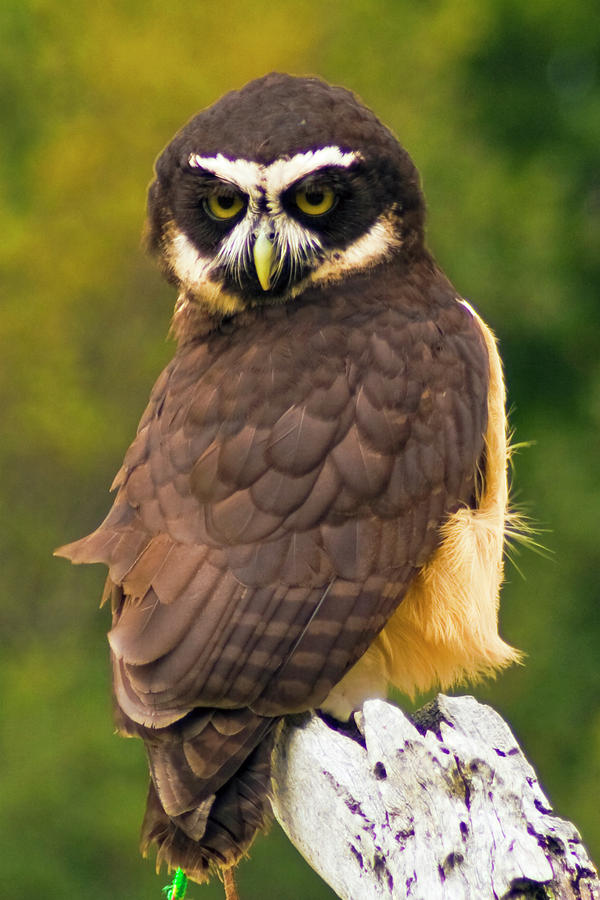
Spectacled Owl

Spectacled owls, along with two other species, belong to the genus Pulsatrix, which is part of the family Strigidae or “typical” owls. The owls in the genus Pulsatrix are large, have stout beaks, strong feet and dark faces outlined by light feathers. The range of the spectacled owl reaches from southern Mexico, south to Paraguay, southern Brazil and northern Argentina. They occupy a variety of habitats from thick, humid rain forests and mangroves, to open woodlands. Spectacled owls have been observed at elevations up to 4,000 feet (1,220 m), but they predominately live at lower elevations. The spectacled owl stands approximately 17-19 inches (43-48 cm) tall and weighs 21-33 ounces (590-950 g). As with most raptors, the female is larger than the male. These large owls have dark heads and backs and buff-colored fronts. They have no ear-tufts. Spectacled owls have an unmistakable face pattern. Light circles around their yellow eyes give them the appearance of wearing glasses or spectacles; this accounts for their name. Juveniles are even more striking, often called “white owls” by local populations. Juveniles have white heads and bodies, dark brown wings and brown to black facial masks. Nesting can occur from January to August. Spectacled owls are cavity nesters, seeking out holes in trees to nest. Clutch size is normally two white eggs, with incubation lasting about 36 days. Approximately six to eight weeks after they hatch, fledglings are ready to take their first flight. The spectacled owl has a variety of distinct calls in the wild. Both sexes utter a rapid series of about seven low-pitched, short, rattling hoots sounding like hoo-hoo-hoo-hoo-hoo-hoo-hoo. Some who have listened to this call have remarked that it sounds something like a woodpecker's tapping. Another call used during flight is a short “whistle” that sounds like wer, which is often repeated about every 10 seconds. When the spectacled owl is alarmed, it may produce three or four descending low hoots that sound something like a growl. Juveniles produce more of a raspy call, “kweew.” The spectacled owl appears to be especially vocal on moonlit nights.

Japanese Long Tailed Tit

The long-tailed tit is a small, fluffy, pinkish bird; it would be the Bridget Jones of the bird world if only it were better fed. The flanks and shoulders are pink-brown; the eyes red; the wings black; and the tail, which is longer than the body, is black with a thin, white border. Like the English name, the Japanese name for the bird refers to the distinctive tail: It means “long handle.” Total length (including tail): 15 cm; wingspan: 18 cm. The bill is very small, and although long-tailed tits do not have much of a song, they make high-pitched “tsee-tsee-tsee” calls. Long-tailed tits are common residents of Japan, found from Hokkaido to Kyushu. They can be seen year-round. A social bird, they are often found in flocks of 20-30 birds, twittering in tall trees. They are acrobatic and energetic, and can be seen hanging upside-down on twigs searching for food. Their favored habitat is woodland, scrubland, farmland, parks and gardens. In winter they form flocks with other tit species. The nest of the long-tailed tit is a globular masterpiece of careful construction. Both the male and female in a pair cooperate to build it, using moss and lichen, animal wool, hair and fur, and silk from spiders’ webs. The resulting nest is lined with feathers (sometimes more than 2,000), forming a warm, elastic ball with a tiny side entrance. Construction may take up to three weeks. In this nest the female lays around a dozen small eggs that are about 14 × 10 mm and white with pink-red spots. As the chicks grow, the elastic nest grows too. Timing is crucial: If the nest is built before the spring leaves have opened, then jays and magpies will be able to see it and plunder it for eggs. The ready social behavior of the long-tailed tit pays off during the raising of the young: Other birds that have failed to breed often assist the parents, bringing food for the young. With so many mouths to feed, the parents benefit from the extra help. Long-tailed tits are vulnerable to the weather, and cold winters kill many individuals. However, their large brood sizes mean the populations can quickly recover. There is some data suggesting that long-tailed tits are starting to lay their eggs earlier in the year. The shift might be due to climatic changes and global warming.

King Eider

The king eider (Somateria spectabilis) is a large sea duck that breeds along Northern Hemisphere Arctic coasts of northeast Europe, North America and Asia. The birds spend most of the year in coastal marine ecosystems at high latitudes, and migrate to Arctic tundra to breed in June and July. They lay four to seven eggs in a scrape on the ground lined with grass and down. The king eider is circumpolar, found throughout the Arctic. It breeds on the Arctic coast of Alaska, Canada, Greenland, Svalbard and Russia, using a variety of tundra habitats. It winters in arctic and subarctic marine areas, most notably in the Bering Sea, the west coast of Greenland, eastern Canada and northern Norway. Wintering birds can form large flocks on suitable coastal waters, with some flocks exceeding 100,000 birds. It also occurs annually off the northeastern United States, Scotland and Kamchatka. The king eider is a large sea duck, measuring 50–70 cm (20–28 in) in length with a wingspan of 86–102 cm (34–40 in). Males are, on average, heavier than females, with a mean weight of 1.668 kg (3.68 lb) for males and 1.567 kg (3.45 lb) for females.[9] An individual bird's mass can vary considerably from season to season—from as little as 0.9 kg (2.0 lb) to as much as 2.2 kg (4.9 lb). Like all eiders, the species is sexually dimorphic; the male is slightly larger and, in breeding plumage, much more colourful than the female. The male is unmistakable with its mostly black body, buff-tinged white breast and multicoloured head. The head, nape and neck are a pale bluish grey. The cheek is pale green. The bill, separated rom the face by a thin black line, is red with a white nail and a large, distinctive yellow knob. Some tertials are curved up and form "spurs" along the back.

Saddle-billed Stork

The saddle-billed stork (Ephippiorhynchus senegalensis) is a large wading bird in the stork family, Ciconiidae. It is a widespread species which is a resident breeder in sub-Saharan Africa from Sudan, Ethiopia and Kenya south to South Africa, and in The Gambia, Senegal, Côte d'Ivoire and Chad in west Africa. This is a close relative of the widespread Asian black-necked stork, the only other member of the genus Ephippiorhynchus. This is a huge bird that regularly attains a height of 150 cm (59 in), a length of 142 cm (56 in) and a 2.4–2.7 m (7.9–8.9 ft) wingspan. The male is larger and heavier than the female, with a range of 5.1–7.52 kg (11.2–16.6 lb), with a mean mass of 6.38 kg (14.1 lb). The female is usually between 5 and 6.84 kg (11.0 and 15.1 lb), wit a mean mass of 5.95 kg (13.1 lb). It is probably the tallest of the storks (though not the heaviest), due in no small part to it extremely long legs (tarsus length is up to 36.5 cm (14.4 in)). The long bill measures from 27.3 to 36 cm (10.7 to 14.2 in). The sexes can be readily distinguished by the golden yellow irises of the female and the brown irises and dangling yellow wattles of the male. It is spectacularly plumaged, identical in male and female when perched but the female shows much more white in the primaries in flight. The head, neck, back, wings, and tail are iridescent black, with the rest of the body and the primary flight feathers being white. Juveniles are browner grey in plumage. The massive bill is red with a black band and a yellow frontal shield (the "saddle"). The legs and feet are black with pink hocks. On the chest is a bare red patch of skin, whose colour darkens during breeding season. They are silent except for bill-clattering at the nest. Like most storks, these fly with the neck outstretched, not retracted like a heron; in flight, the large heavy bill is kept drooping somewhat below belly height, giving these birds a very unusual appearance to those who see them for the first time. To experienced birdwatchers on the other hand, this makes them easily recognizable even if seen from a distance. It has been suggested that due to the large size and unusual appearance in flight, this species is the basis for the "big bird" and kongamato cryptids.

White-crested Turaco

White-crested turacos are one of the most colourful African birds. Their red and green colour is due to a special copper pigmentation which is unique to the turaco species. Look for a flash of red feathers on the underside of the turaco's wings as it hops through the trees. All turaco species have these feathers, which they show off during courtship displays. Turacos can fly, but they spend most of their time hopping through the trees of their forest habitat. Their loud calls help them communicate in the dense foliage. Both the female and male turacos sit on the eggs and help rear the chicks. Another distinctive feature is the birds’ toes. Each claw has a pair of toes that face forward and a pair that face backwards, so each bird has eight toes in total. All turacos have a more flexible toe on the rear of each claw that can move to the side, making it easier for the birds to grip branches and climb trees. The striking White Crested can easily be identified by its white crest, chin, neck and nape. In Africa, they have a large range and are considered common. They can be found in Cameroon, Central African Republic, Chad, Congo, Kenya, Nigeria, Sudan, and Uganda. Their preferred habitats include riverine forestry from 100 to 2200m, open woodland, and drier scrub areas.This species feeds on fruits, seeds, leaves and flowers, as well as the occasional arthropod. This species has an extremely large range, and hence does not approach the thresholds for Vulnerable under the range size criterion (Extent of Occurrence <20,000 km2 combined with a declining or fluctuating range size, habitat extent/quality, or population size and a small number of locations or severe fragmentation). The population trend appears to be stable, and hence the species does not approach the thresholds for Vulnerable under the population trend criterion (>30% decline over ten years or three generations). The population size has not been quantified, but it is not believed to approach the thresholds for Vulnerable under the population size criterion (<10,000 mature individuals with a continuing decline estimated to be >10% in ten years or three generations, or with a specified population structure). For these reasons the species is evaluated as Least Concern.

Thursday, August 20, 2015

Knysna Turaco / Knysna Loerie

Found almost exclusively  in South Africa, in the narrow strip of forest extending from Mpumalanga, through KwaZulu-Natal, Eastern and Western Cape provinces. Can be found also in Mozambique and Swaziland, though, with an estimated global extent of occurrence of 20 000-50 000 km, though most of its population is concentrated in coastal Eastern Cape and KwaZulu-Natal. The Knysna Turaco, or, in South Africa, Knysna Lourie, is a large turaco – 40-42cm from beak to tail, 260-380g -, one of a group of African near-passerine birds. It is a resident breeder in the mature evergreen forests of southern and eastern South Africa. It is an unmistakable bird, although often inconspicuous in the treetops. It was formerly sometimes considered to be a subspecies of the Green Turaco of West Africa but vocal and chromosomal differences have now led to it being classified as a specie of its own.. The easiest way to identify it from other green turacos is by the white tip on its rounded crest. The Knysna Lourie has a sharply curved short but thick orange-red bill and a white line just under the eye that contrast with its mainly green plumage. It has a tall green crest, which is tipped with white. The eye is brown and the eye-ring deep red. In flight, Knysna Turaco shows conspicuous red primary flight feathers. Sexes are similar. This bird family is known as Louries in South Africa, but the international name is Turaco. Turacos  (the 10 species of the Tauraco and the 2 of the Musophaga) are the only birds to possess true red and green  color. When you look at most birds, the color you are seeing is a reflection produced by the feather structure. The turaco's red pigment (turacin) and green pigment (turacoverdin) both contain copper. In fact, if you stirred a glass of water  with a red turaco feather, the water would turn pink! In museum species, the pigments deepen with age because the copper begins to oxidize. These birds mannage to maintain their colors throughout the year. The Knysna Lourie is thought to use its red wing feathers to escape predators. Indeed, when it flies, the predators tend to focus on the most visible color and follow the red patch. As the Lourie lends and folds its wings, the red feathers of the wings become invisible and the Lourie has a chance of escaping unseen.

Barn Owl

The Barn Owl is a medium sized owl with no ear-tufts and a heart-shaped face. These pale, nearly worldwide birds are closely associated with man through their traditional use of barn lofts and church steeples as nesting sites. The species name "alba" refers to the colour white. Other names for the Barn Owl have included Monkey-faced Owl, Ghost Owl, Church Owl, Death Owl, Hissing Owl, Hobgoblin or Hobby Owl, Golden Owl, Silver Owl, White Owl, Night Owl, Rat Owl, Scritch Owl, Screech Owl, Straw Owl, Barnyard Owl and Delicate Owl. The facial disc is white with a brown edge, and with a brownish wash between the lower edge of the eyes and the base of the whitish-pink bill. Eyes are brownish-black. The crown and upperparts are yellowish-brown to orange-buff, covered partly by a pale ashy-grey veil marked with scattered white spots surrounded by black. The tail is similar, with a few darker bars and with white dots near the tips of the feathers. Underparts are whitish or pure white with a few small, dark drop-shaped spots (often more on females). Legs are feathered white nearly to the base of the mostly bare toes, which are pale greyish-brown and dirty yellowish underneath. Claws are brownish-black. The Barn Owl calls infrequently, the usual call being a drawn-out rasping screech. The courtship call of male at nest is a shrill repetitive twittering. Adults returning to a nest may give a low, frog-like croak. When surprised in its roosting hollow or nest, it makes hissing and rasping noises and snapping sounds that are often called bill snapping, but possibly made by clicking the tongue. Barn Owls specialise in hunting small ground mammals, and the vast majority of their food consists of small rodents. Voles (field mice) are an important food item, as well as pocket gophers, shrews, mice and rats. Barn Owls breed rapidly in response to mouse plagues. Other prey may include baby rabbits, bats, frogs, lizards, birds and insects. Prey are usually located by quartering up and down likely looking land - particularly open grassland. They also use low perches such as fence posts to seek quarry.

Wednesday, August 19, 2015

Crested Auklet

The Crested Auklet (Aethia cristatella) is a small, peculiar-looking seabird with a bright orange bill (during breeding season) and an eye-catching crest ornament, which is present in both sexes. Males and females prefer mates with large crests and have a distinctive tangerine odor to their plumage. During the breeding season, this bird is found only in the Bering Sea and adjacent North Pacific Ocean, and nests in colonies on remote coastlines and islands. They are an extremely social species and nest in mixed colonies with Least Auklets (Aethia pusilla) ranging in size from a few hundred to possibly more than a million pairs. Nests are located deep in rock crevices on sea-facing talus slopes, cliffs, boulder fields, and lava flows making it difficult to census them. Summer foods include marine invertebrates and less frequently fish and squid. Crested Auklets often forage in large flocks. To capture their food, birds dive from the surface and pursue the prey in underwater “flight”. In Alaska, Crested Auklets are found in the Bering Sea, on the Aleutian Islands, and on the Shumagin Islands. A total of 43 colony sites are known with notable centers of breeding abundance in the northern Bering Sea and the western Aleutian Islands. Virtually all colonies are on volcanic islands adjacent to deep water or where deep oceanic water, filled with energy-rich crustaceans, is transported past the colonies. The single exception to this is St. Matthew Island where the auklets feed on lower quality (less nutrient-rich), ocean shelf crustaceans.

Resplendent Quetzal

The resplendent quetzal is an aptly named bird that many consider among the world's most beautiful. These vibrantly colored animals live in the mountainous, tropical forests of Central America where they eat fruit, insects, lizards, and other small creatures. During mating season, male quetzals grow twin tail feathers that form an amazing train up to three feet (one meter) long. Females do not have long trains, but they do share the brilliant blue, green, and red coloring of their mates. Male colors tend to be more vibrant. Resplendent quetzal pairs use their powerful beaks to hollow hole nests in rotted trees or stumps. Inside, they take turns incubating two or three eggs—though males have such long tails that they sometimes stick outside the nest. Young quetzals can fly at about three weeks of age, but males do not begin to grow their long tail plumes for three years. Resplendent quetzals are also known as Guatemalan quetzals, and the birds are the symbol of that nation. Guatemala also trades in currency known as the "quetzal." Unfortunately, these striking birds are threatened in Guatemala and elsewhere throughout their range. They are sometimes trapped for captivity or killed, but their primary threat is the disappearance of their tropical forest homes. In some areas, most notably Costa Rica's cloud forests, protected lands preserve habitat for the birds and provide opportunities for ecotourists and eager bird watchers from around the globe. Such admirers continue a long history of adoration for the quetzal. The bird was sacred to the ancient Maya and Aztec peoples, and royalty and priests wore its feathers during ceremonies.

Northern Cassowary

The northern cassowary (Casuarius unappendiculatus) also known as the single (one)-wattled cassowary or gold(en)-neck(ed) cassowary, is a large, stocky flightless bird of northern New Guinea. They are members of the superorder Paleognathae.  Edward Blyth first identified the northern cassowary from a specimen from an aviary located in Calcutta, India, in 1860. The genus name Casuarius is derived from the Malay word kesuari "cassowary", while the species name unappendiculatus refers to the species' single wattle. Officially, there are no subspecies, though some authors list several subspecies. It has hard and stiff black plumage, blue facial skin and a casque on top of the head. It has a bright red or yellow colored neck and wattle. The feet are huge and strong with long, dagger-like claw on its inner toe. The sexes are similar. The male, at 30 to 37 kg (66 to 82 lb), is smaller than female, at an average of 58 kg (128 lb), making it the world's fourth heaviest living bird species after the common ostrich, Somali ostrich and the similarly-sized southern cassowary. These birds measure 149 cm (4.89 ft) long and stand 1.5–1.8 m (4.9–5.9 ft) in height. Compared to the southern cassowary, the northern cassowary has a slightly shorter bill, at 12 to 13.7 cm (4.7 to 5.4 in), but a slightly longer tarsal length, at 28 to 33.2 cm (11.0 to 13.1 in). Casuariidae is the family of the northern cassowary. There are only four members, three of which are Cassowaries; the other, the only remaining species of emu. All are similar. Emus were classified in a different family until it was decided that they are similar enough to the cassowaries that they could be classified in the same family. All four members of the Casuariidae are large flightless birds. The northern cassowary and the emu share homologous features. For example, both have a blue patch of colour on their face/neck, but the functions of these differ. The emu’s patch is of a paler colour and is used as a form of camouflage where it is located. The northern cassowary’s patch of blue is brighter, and is used for attracting mates.

Tuesday, August 18, 2015

Secretary Bird

The secretary bird’s English name was once thought to come from the 1800s, when Europeans first spotted these birds. Back then, male secretaries wore gray tailcoats and dark knee-length pants. They also used goose-quill pens that they carried behind their ears. This long-legged bird shares many of these same physical features: long, dark quills at the back of the head; long, gray wing and tail feathers that resemble a tailcoat; and black feathers that go midway down the legs like short pants. It's fun to imagine how the two "secretaries" compare! Secretary birds are distantly related to buzzards, vultures, harriers, and kites. But unlike their raptor cousins, secretary birds spend most of their time on the ground. Native to Africa, they are found south of the Sahara Desert, from Senegal east to Somalia and south to South Africa. Standing over four feet tall, the elegant birds cruise through grasses on long legs while looking for a bite to eat. Secretary birds prefer savannas with scattered acacia trees and short grasses where they can easily see while strolling.
But can they fly? Of course! They may spend their days on the ground, but secretary birds are good fliers and nest and roost high up in acacia trees at night. In flight, their long legs trail behind them in the air. Secretary birds and caracaras are the only terrestrial birds of prey, hunting for their food on foot. Adults are often seen working in loose pairs, or even small family groups, stalking through grass in search of small mammals, reptiles, birds, and large insects. They are well known for their ability to catch and kill snakes of all sorts, even venomous ones! Secretary birds are clever enough to take advantage of recent fires, scavenging throughout the burn site for small animals that were unable to escape the blaze.

Jacobin Pigeon

The Jacobin is one of many very old domestic pigeon breeds. Undisputed knowledge of its origin simply does not exist. Some accounts place the origin of the breed in India, while others say Cyprus. What can be established is that by the 16th century, Jacobins had arrived in Europe to stay. The Jacobin received its European name because of the hood of feathers enveloping the back and both sides of its head. This hood resembles the cap on garments worn by the Jacobin order of monks. For others, Jacobins bring back memories, not of monks, but rather of women with feathery boas draped about their necks. It is an excellent exhibition breed, attracting attention everywhere it is shown. The Jacobin is bred throughout the world, with the nucleus of breeders located in Germany and England. Queen Victoria prized the Jacobins above all other varieties and made a point of obtaining outstanding specimens from time to time to improve her own birds.  She did not compete in shows, but Jacobin fanciers sent some of their best birds to her lofts and frequently received from her even better individuals, produced under the Queen's loving supervision. Years ago it was regarded as rather small, with the rule being, the smaller, the better. Today's bird is rather of medium size, but thin, and looks considerably larger than it really is, owing to its hood feathering, and its long length of flight feathers and tail. The most remarkable feature of the Jacobin is its extremely ornate feather adornment starting at the base of the neck and forming a chain going beyond the top of the head. Viewed from the side, the feathers grow out in all directions from the neck, forming what is called a rosette. This chain and rosette compose the hood that completely engulfs the top and sides of the head, covering the bird's face from every angle except directly from the front. The more pronounced the hood and chain, the higher the quality of the specimen.

Horned Puffin

The horned puffin is a small, pigeon-sized bird with black uppersides and a white chest and undersides. It has a white face and cheeks with a small black "horn" above its eyes and a thin, dark line that runs from from its eyes to the nape of its neck . It has a large, triangular orange bill with a red tip. It has bright orange legs and webbed feet with claws on the ends of them. In the winter its bill is smaller; its feathers are grayer and its face is darker. Males and females look similar, but the male's bill is bigger and brighter than the female's bill and the male is a little larger. Because of its colorful bill, the horned puffin is sometimes called the sea parrot. Horned puffins exhibit a types of deceptive coloration called counter shading. Animals with countershading have different colors on their backs and stomachs. The puffin's dark coloring on the top makes it hard for predators above them to see them because the puffin blends into the dark water. The light coloring on the underside of the puffin helps them to blend into the sunlit water above and makes locating the puffin more difficult for predators swimming under them. The horned puffin is pelagic. A pelagic animal lives on the open sea. In breeding season it can be found on sea cliffs or on rocky islets. In the summer puffins will come in from the open ocean to mate. Puffins form pairs that will mate for life. A pair will usually build a nest in a crevice in a cliff or in a hole between boulders. The female lays only one egg a year. Both parents incubate the egg. They place the egg under a wing and then lean their body against the egg. The egg hatches in about 40 days and both parents feed and protect the chick. When the chick fledges in 40 days the parents will leave the chick and return to the open ocean. The chick will also fly out to open ocean waters and remain there for at least two years. Puffins breed in large colonies with the tufted puffin.